SEO agency New York: how to read the 2026 rankings and build a real shortlist
The short answer
The pages ranking for this query are business directories, and they disclose that placement can be bought.
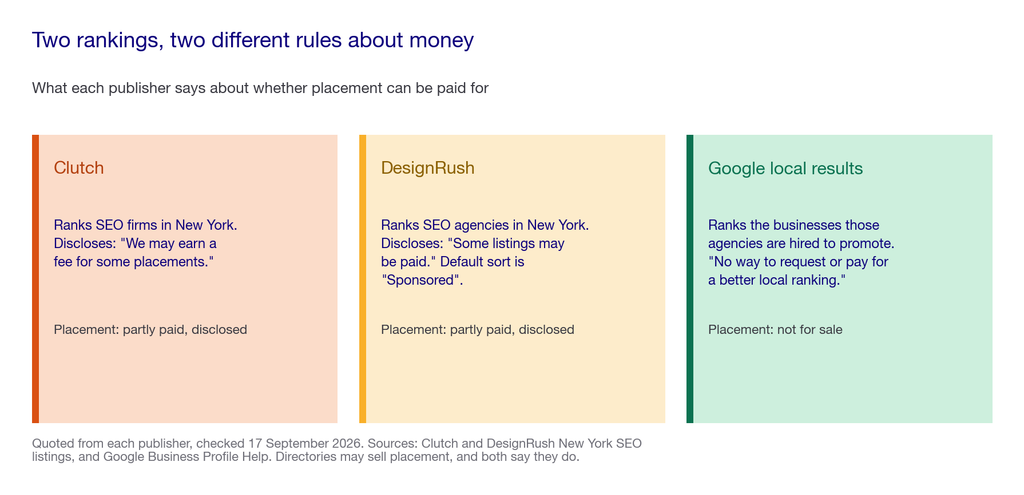
Clutch carries the line “We may earn a fee for some placements.” DesignRush states “Some listings may be paid,” and its default sort order is literally “Sponsored.” So the first agency you see is not the best agency in New York. It is the agency whose position on that page is compatible with that page’s business model.
Meanwhile Google says the opposite about its own local results: “There’s no way to request or pay for a better local ranking on Google.”
Both things are fine. Directories are allowed to sell placement, and they told you. But it means the ranking is not the finding. The useful part of those pages is the data underneath: published hourly rates and minimum project sizes, which almost nothing else in this category discloses.
Below we use that data. We also name the fork most of these lists never mention: an agency in New York and an agency for the New York market are two different purchases.
That is the split we work to. Pepper is an agentic organic growth engine, not an SEO agency. This page comes out of what we run: organic for more than 250 enterprises across eight years, more than 10 million tracked prompts, and the questions buyers put to us in client reviews. Customers log in and run the platform themselves, with a Pepper growth team attached to the account doing the work alongside them. Book a growth audit and we will show you what five AI engines currently say about your brand before you brief anybody.
Key takeaways
Key takeaways from an afternoon in the directories, Google’s own documentation and the agencies’ own websites.
- Both ranking directories disclose paid placement. Clutch: “We may earn a fee for some placements.” DesignRush: “Some listings may be paid,” with Sponsored as the default sort.
- Google says the opposite about local results. “There’s no way to request or pay for a better local ranking on Google.”
- The top-ranked firm on the New York list is headquartered in New Jersey. SmartSites lists one office, at 45 Eisenhower Drive, Paramus, New Jersey, and no New York address. It is a well-reviewed firm. It is not evidence of New York proximity.
- The rate data is the genuinely useful part. Published hourly rates across the New York listings run from $100 to $300, with minimum project sizes from $1,000 to $25,000.
- Two purchases share one query. Hiring in New York is about access to people. Ranking in New York is local SEO, where one of Google’s three stated factors is your physical distance from the searcher and no agency can change it.
- Nobody can sell you proximity. If your customers are in Manhattan and your office is not, that is a fixed input, and an agency promising to fix it is promising something Google says is not for sale.
What is an SEO agency in New York, and what are you actually buying?
Two different products answer to this search, and conflating them is the most expensive mistake in the category.
An agency in New York means location of staff. You are buying access: people in your timezone, in the room for a quarterly review, plugged into a talent market that is genuinely deep. This has real value and it has nothing to do with how search works.
An agency for the New York market means you want to be found by people in New York. That is local SEO, and it runs on a mechanism Google publishes openly.
Google states three factors determine local ranking:
- Relevance, which Google defines as “how well a Business Profile matches what someone is searching for.” An agency can improve this. Categories, services, attributes, and the content behind them.
- Distance, which Google defines as “how far each business is from the customer who’s searching.” No agency can improve this. It is your address.
- Prominence, which Google defines as “how well-known a business is. Prominent places are more likely to show up in search results.” An agency can improve this, slowly, through reviews, citations and genuine coverage. It is the same slow authority work that decides whether AI engines cite you, which we traced in our GEO best practices playbook.
So two of the three are workable and one is fixed. Any proposal that implies otherwise is worth reading twice. And Google closes the door explicitly: “There’s no way to request or pay for a better local ranking on Google.”
The third product nobody puts on the list
There is now a third product hiding in the same query, which is visibility inside AI answers. That one has no local mechanism at all. ChatGPT has no equivalent of a Business Profile and no distance factor. The tooling that measures it is a separate market, compared in best AEO platforms. We untangle the terminology in AEO, GEO, AIO and LLMO explained.
How we built this list, and what we did not do
Let us be clear about what this is not. There is no outcome data on any of these firms, here or on any page currently ranking for this query, so nobody can honestly rank them.
What we did instead, on 17 September 2026:
| What we checked | Weight in our read | Why |
|---|---|---|
| Published hourly rate | 30 | The only comparable number in the category |
| Published minimum project size | 25 | Tells you who the firm is built for, faster than any positioning line |
| Verified office location | 20 | The query implies proximity. We checked whether it exists |
| Named AI search service | 15 | Whether the firm has a stated offer, and what it calls it |
| Named clients on own site | 10 | Logos you can check, not logos in a directory listing |
Total 100. Rate and minimum carry more than half between them, because they are the two facts a buyer can actually compare across firms, and almost nobody else publishes them. We publish our own weights for the same reason we suggest you write yours down, and the longer version sits in our GEO agency ranking methodology.
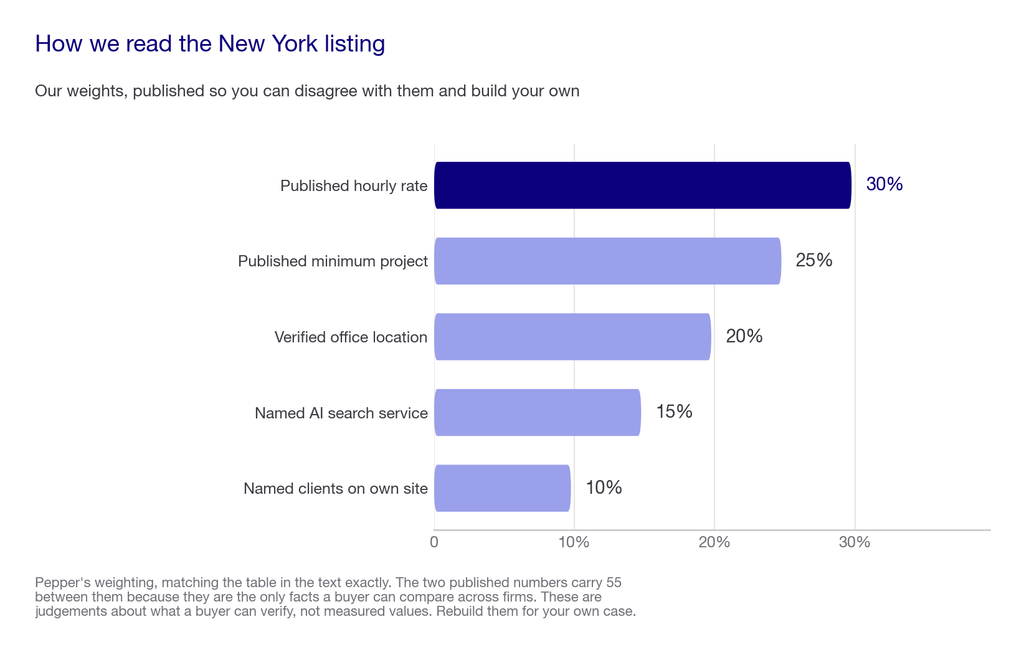
Rate and minimum data come from the Clutch and DesignRush New York listings. Office locations and service names come from each firm’s own website. Where a firm publishes nothing, we say “not published” rather than estimating.
New York SEO agencies at a glance
Disclosure: Pepper appears here. We are not an SEO agency and we have not ranked ourselves against these firms. We lead the table because we are the publisher, in a separate category, with the same columns filled in so you can judge fit yourself.
| Firm | Published hourly rate | Minimum project | AI search term |
|---|---|---|---|
| SmartSites | $100 to $149 | $1,000+ | Not named on homepage |
| SEO Image | $200 to $300 | $1,000+ | AI Search Optimization |
| OSMOS | $150 to $199 | $25,000+ | Not verified |
| Primary Position | $100 to $149 | $1,000+ | Not verified |
| Silverback Strategies | Not listed | $10,000+ | AI Search Optimization |
| Sure Oak | Not listed | Not listed | AISO, AEO/GEO |
Rates and minimums as listed on Clutch’s New York SEO page, checked 17 September 2026. Office locations and AI search terms come from each firm’s own website. “Not verified” means we did not open that firm’s site in this pass and will not repeat a directory’s claim as our own.
Pepper
- What it is: an agentic organic growth engine, not an agency. The distinction matters for this decision, so we state it rather than blur it.
- Where we are: not a New York company. If being able to walk to your agency is the requirement, we are not that, and we will say so on the first call rather than after it.
- How it runs: you hold the logins. You set up the workspace, connect GA4 and Search Console, manage themes and prompts, and read the analytics yourself. A Pepper growth team is attached and does the work alongside you, running the agents in Agent Atlas.
- Engines tracked: ChatGPT, Perplexity, Gemini, Claude and Google AI Overviews.
- Metrics you get: Brand Visibility, Domain Prompt Presence and Share of Voice. The gap between the first two is the citability problem, and naming it is how you fix it. The framework is Visibility, Citability and Retrievability.
- Credentials: eight years, 250-plus enterprises, more than 10 million tracked prompts, with the work published in our case studies.
- Published pricing: no. We quote on scope, and we give you the number on the first call.
- Where it falls short: we are not a local SEO shop. If your problem is ranking a three-location business in the Google local pack, a specialist with Business Profile discipline will serve you better than we will, and we would rather tell you that now.
SmartSites
- Published rate: $100 to $149 per hour, minimum project $1,000, as listed on Clutch.
- Own positioning: “Award Winning Digital Marketing Agency.”
- Verified location: one office, 45 Eisenhower Drive, Suite 520, Paramus, New Jersey. No New York office is listed on its contact page.
- AI search offer: none named on the homepage. Search work is described as “Organic SEO.”
- Scale claims on own site: “900+ Websites Launched” and “$100M+ Client Revenue Generated.”
- Where it falls short: it tops a list of New York SEO companies while listing no New York address, and names no AI search service. Paramus is twenty miles from Manhattan and this says nothing about the quality of the work. It does mean the list is not delivering the proximity the query implies.
SEO Image
- Published rate: $200 to $300 per hour, the highest band in the listing, minimum project $1,000.
- Own positioning: “We don’t just deliver traffic; we deliver your brand.”
- Verified location: genuinely New York. 535 5th Ave, 4th floor, plus a Long Island office in Melville.
- AI search offer: the most developed language in this set. “AI Search Optimization” as the primary heading, with “Generative Engine Optimization” and “LLM SEO” also used.
- Where it falls short: three different names for AI search work on one site makes a proposal harder to compare against anyone else’s, and no pricing is published beyond the directory band.
OSMOS
- Published rate: $150 to $199 per hour, with a $25,000 minimum project, the highest floor in the listing.
- What the minimum tells you: this is a firm built for funded scale-ups and enterprise, not for a single-location business. The minimum is more informative than any positioning line.
- Where it falls short: we did not verify its own site in this pass, so treat the rate and minimum as directory data rather than as our own check.
Primary Position
- Published rate: $100 to $149 per hour, minimum project $1,000.
- What that combination tells you: an entry point low enough for a small business, in a listing where the top minimum is twenty five times higher.
- Where it falls short: unverified at source in this pass, same caveat as above.
Silverback Strategies
- Published rate: not listed. Minimum project $10,000.
- Own positioning: “The Marketing Agency Your CFO Will Brag About.”
- Services: paid search, paid social, programmatic, SEO, AI search, content, media mix modelling, incrementality testing and CRO.
- AI search offer: “AI Search Optimization.”
- Where it falls short: not a New York company, and it appears on New York lists anyway. The measurement services are the genuinely differentiated part. Ask to see an incrementality readout rather than assuming one exists.
Sure Oak
- Published rate: not listed in the New York listing.
- Own positioning: “Build Authority. Drive More Leads.”
- AI search offer: “AISO,” described as AEO/GEO, covering ChatGPT, Perplexity and Google AI Overviews.
- Third-party signal: holds a Clutch financial services award for 2025.
- Where it falls short: publishes no rate anywhere we could find, which in a listing where six competitors do publish one is a choice worth asking about.
SEO agency New York pricing: rates and minimums
This is the one thing the directories do better than the agency websites, and it is worth taking.
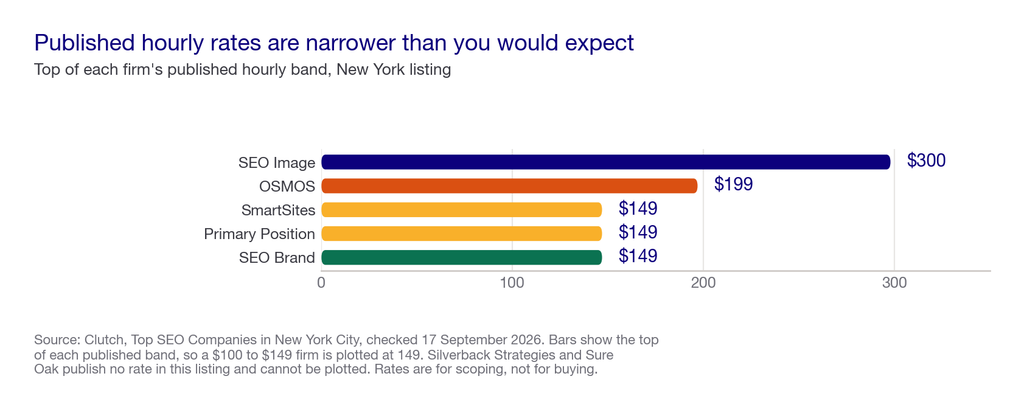
- The rate range is narrower than you would expect. Four of the six firms with a published band sit between $100 and $199 per hour. One sits at $200 to $300. The spread is roughly threefold, not tenfold.
- The minimum project size is the real differentiator. It runs from $1,000 to $25,000 in the same listing. That is a twenty five times spread, and it tells you who the firm is built to serve far more reliably than the hourly rate does.
- Read the two together. A $150 rate with a $25,000 minimum is an enterprise firm. The same rate with a $1,000 minimum is a firm that will take a small local business. Neither is better. They are different companies.
- Hourly rates are for scoping, not for buying. Almost nobody sells SEO by the hour in practice. The number tells you where the firm places itself in the market, and that is its actual use.
Why the floor matters more than the rate
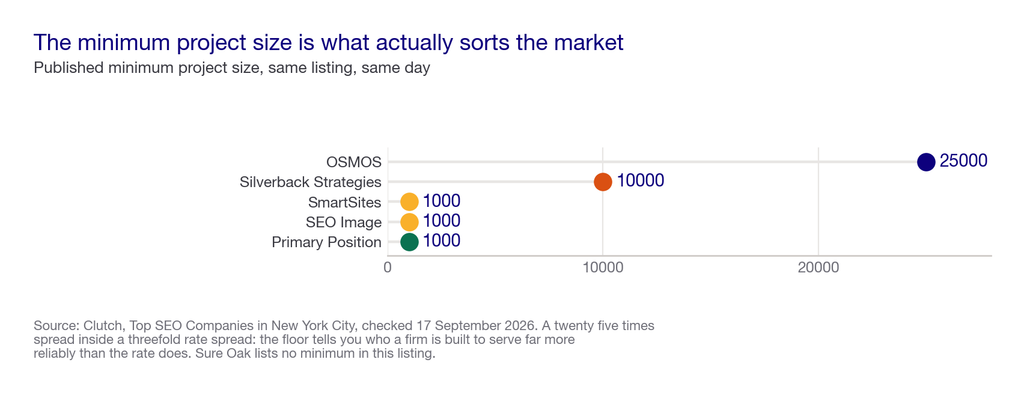
We do not publish a rate card either, and it would be poor form to criticise anyone else for that. What we will do is give you the number on the first call rather than after three meetings. We set out how the wider agency market prices itself, and why the published numbers are so rare, in our piece on banking and financial SEO agencies.
How to choose an SEO agency in New York
This is the section worth slowing down for. Here is the sequence we would run if we were buying rather than selling.
Step one: decide whether you need New York at all
Write down why location is on your list. There are only three honest answers, and they lead to different shortlists.
You want people in the room. Legitimate, and it narrows the field fast. Verify the office exists, because the top firm on the New York directory list does not list a New York address.
You want to rank in the New York market. Location of your agency is irrelevant to this. Location of your business is not, because Google names distance as one of three local ranking factors. Buy local SEO discipline, wherever it sits.
You assumed local was better. It usually is not, for anything except access. Say so out loud and you have just widened your shortlist to the whole country at no cost.
Step two: score the shortlist on a 100-point scale
Rebuild this for your own situation, from each firm’s own website rather than from a directory listing. It takes about twenty minutes and it is the highest-leverage twenty minutes in this process.
| Criterion | Weight | What earns full marks |
|---|---|---|
| Verified office where you need it | 25 | An address on the firm’s own contact page, not the directory |
| Local pack versus organic separated | 20 | They split the two in the first conversation |
| Engine coverage, named | 15 | Named engines and a stated reporting frequency |
| Data and login ownership | 15 | You keep GA4, Search Console, Business Profile and platform access |
| Cost transparency | 10 | A number on the first call, not after three meetings |
| Named clients you can check | 10 | On the firm’s own site, in your category |
| Reporting you can audit | 5 | Raw answers and cited URLs, not only a chart |
Total 100. The first two carry nearly half between them, which is deliberate: one tests whether the premise of your search is real, and the other tests whether the firm understands that you have two different search problems.
The two checks that catch the most: open the contact page and confirm the office, and search the site for the AI search service to see whether it exists and what it is called.
Step three: ask the five questions that separate them
- “Where do the people on my account actually sit?” Not where the company is registered. Which city, which timezone, and will any of them be in a room with me.
- “Which of my rankings are local pack and which are organic?” These need different work. A firm that does not separate them in the first conversation will not separate them in the reporting either. Our view on which side should sit in house is in the AI search team ownership model.
- “Which AI engines do you measure, and how often?” Named engines and a frequency. Vague answers here predict vague reporting later.
- “Who owns the logins and the data?” If they run everything and send a monthly deck, you are buying a report rather than a capability. You keep nothing when the contract ends.
- “What would you tell us not to do?” A partner with a view answers immediately. This is the question that most reliably separates practitioners from sales teams.
Step four: run a live test before the full retainer
Paper evaluations reward whoever writes the best deck. Run a real one instead.
Give each finalist the same 25 prompts a customer in your category would type, and 90 days. Include local phrasing and non-local phrasing, because they behave differently: “best commercial real estate broker in midtown”, “SOC 2 compliance software for fintech”, “emergency plumber upper west side”. Ask for a baseline in week one and a movement report at the end.
A weaker firm will report rankings and traffic. A stronger one will report which prompts you appear in, whether the local pack or the organic result moved, and which pages the AI engines actually cited. The gap between Brand Visibility and Domain Prompt Presence is the tell: high mentions with low domain citations means engines are describing you using somebody else’s pages.
Step five: watch for these red flags
- “We can get you into the local pack.” Google states there is no way to request or pay for a better local ranking. Distance is fixed by your address.
- A directory rank quoted as a credential. Both directories disclose that placement can be paid for. One sorts by sponsored by default.
- A New York address that appears only in the directory listing, not on the firm’s own contact page.
- One proposal covering local pack, organic and AI visibility with no separation. Three different mechanisms, three different measurements.
- A guarantee of position, in any pack, in any city. Covered below.
- No question about your Business Profile from a firm you are hiring for local work.
Step six: decide what stays inside, and be willing to wait
Review responses stay inside, because they are your voice and they are public. Business Profile ownership stays inside, because losing it is painful. Relationships with your own location managers stay inside.
And here is the answer that loses us the sale. If you are a single-location New York business whose customers find you through the local pack, you do not need us and you probably do not need a national agency either. You need Business Profile discipline, a genuine review habit and a handful of pages that answer real questions. That is a few thousand dollars of setup and a standing hour a week, not a retainer. Come back when you are opening location three or selling beyond the city.
All of it comes down to one principle: buy the thing that is actually scarce. In New York the scarce thing is rarely SEO skill, which is everywhere and priced within a threefold band. It is usually someone who will tell you which of your three search problems is the one worth funding this year.
What nobody should promise you
- A better local ranking in exchange for money. Google’s own words: “There’s no way to request or pay for a better local ranking on Google.”
- Movement on distance. It is one of the three stated local factors and it is your address. Nobody optimises it.
- A guaranteed position in organic results. Google advises against providers who guarantee rankings, because third parties cannot access internal ranking systems.
- A guaranteed citation in an AI answer. Nobody controls what a model outputs. We will not promise it either.
- That a directory ranking is a quality ranking. It may be, in part. Both directories also tell you placement can be paid for, and you should believe them.
Frequently asked questions
What are the best SEO agencies in New York?
The pages ranking for that question are directories that disclose paid placement, so their order is not a quality ranking. Use their published hourly rates and minimum project sizes instead, then verify each firm’s office and AI search service on its own website.
Do I need a New York agency to rank in New York?
No. Your agency’s location has no effect on rankings. Your own business address does affect local pack results, because Google names distance as one of three local ranking factors, and no agency can change it.
Cost and how the rankings work
How much does an SEO agency in New York cost?
Published hourly rates in the New York directory listing run from $100 to $300. Minimum project sizes run from $1,000 to $25,000 in the same listing, and that minimum tells you far more about who a firm serves than the rate does.
Are Clutch and DesignRush rankings paid?
Partly, and both say so. Clutch states “We may earn a fee for some placements.” DesignRush states “Some listings may be paid,” and its default sort order is Sponsored. Read the data in the listings rather than the order of them.
Can an agency get me into the Google local pack?
It can improve two of the three factors Google names, relevance and prominence. It cannot improve the third, distance, which is set by your address. Google also states there is no way to request or pay for a better local ranking.
Choosing and testing a partner
What should I ask a New York SEO agency before signing?
Ask where the people on your account actually sit, which of your targets are local pack versus organic, which AI engines they measure, who owns the logins and data, and what they would tell you not to do.
How do I test an agency before committing?
Give each finalist the same 25 prompts, mixing local and non-local phrasing, and 90 days. Ask whether the local pack or the organic result moved, and which pages AI engines cited. That separates reporting from results.
Is a big agency better than a small one for SEO?
Neither is better by size. The published minimum project size tells you which one a firm is built for. A $25,000 minimum and a $1,000 minimum in the same rate band are simply two different companies serving two different buyers.
Sources
Directory data, Google documentation and agency details were checked at the primary source on 17 September 2026. Where we could not verify something, we have said so rather than repeating a directory’s claim.
Google documentation
- Google Business Profile Help, Improve your local ranking on Google, checked 17 September 2026. Names three factors: relevance, “how well a Business Profile matches what someone is searching for”; distance, “how far each business is from the customer who’s searching”; and prominence, “how well-known a business is. Prominent places are more likely to show up in search results.” States plainly: “There’s no way to request or pay for a better local ranking on Google.”
- Google Search Central, AI features and your website, 15 May 2026. Places AEO and GEO inside SEO, and advises against providers guaranteeing rankings.
Directories
- Clutch, Top SEO Companies in New York City, checked 17 September 2026. Source of every hourly rate and minimum project size quoted above. Carries the disclosure “We may earn a fee for some placements.”
- DesignRush, Top SEO Agencies in New York, checked 17 September 2026. States “Some listings may be paid.” Default sort order is Sponsored, with alternatives including Top Rated and average hourly price.
Agency sites
- SmartSites contact page, checked 17 September 2026. Lists a single office at 45 Eisenhower Drive, Suite 520, Paramus, New Jersey 07652, and no New York office.
- SEO Image, checked 17 September 2026. Lists 535 5th Ave, 4th floor, New York, NY 10017, and a Melville, NY office.
- Silverback Strategies and Sure Oak, checked 17 September 2026, for positioning and AI search terminology.
On what we did not do
We did not rank these firms and we did not test their work. Rates and minimums are what the directories publish; locations and service names are what the firms publish. We did not open every firm’s website in this pass, and we have marked those rows unverified rather than filling them from a directory. If an agency publishes audited performance data, send it to us and we will add it here with attribution.
Latest Blogs
Most 90-day AI plans are sequenced by how hard the work feels rather than by how long it takes to land. So they spend week one on an llms.txt file that Google states it does not use, and they schedule earned media for phase three, which guarantees no result inside the quarter. This plan inverts that. It orders the work by lead time, starts the slowest thing on day one, and cuts four tactics Google explicitly says are unnecessary.
We priced this category nine days ago. Today we went back to the same four pricing pages to check the numbers before publishing. Three of the four had changed, and two had stopped publishing prices altogether. That is the real answer to what AEO costs in 2026: not a number, but a meter that moves, measured in prompts and responses and engines that are billed separately. Here is how each pricing model works, what unit it charges you for, and which incentive that unit creates.
Ask what AI search traffic is worth and you will be handed a multiplier. The ones in circulation right now run from 13% worse than organic search to 23 times better, a spread of roughly twenty-six fold on the single input your whole business case depends on. They disagree because they are measuring the same behaviour under different attribution models. So this is not a guide to finding the right multiplier. It is a guide to building a model whose assumptions are visible, and to being honest about the half you cannot prove.
Get your hands on the latest news!

Similar Posts

SEO
12 mins read
How to find the topics AI engines actually answer

SEO
15 mins read
What are the best SEO agencies in 2026?

Artificial Intelligence
12 mins read