Most comparisons of SEO optimization tools stop at the feature grid. We priced them instead, and the interesting number turned out to be how many AI prompts each one actually lets you track.
The short answer
Buy a tool when you have people who will use it, and buy an agency when you need the work done. The hard part in 2026 is that the AI visibility half of the job sits awkwardly across both.
Four findings from pricing everything on the same day.
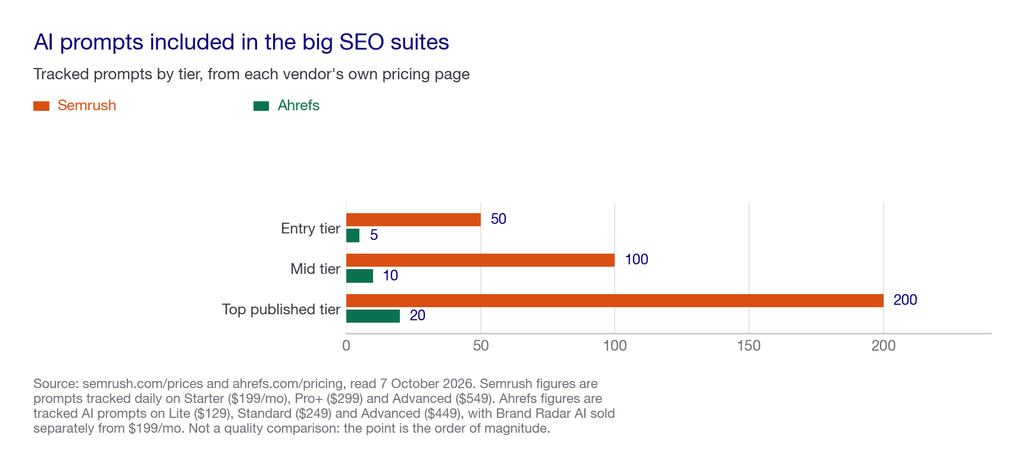
- The classic suites include AI tracking, but barely. Ahrefs includes 5 tracked AI prompts on Lite at $129 a month and 20 on Advanced at $449. Semrush includes 50 daily prompts on Starter at $199 a month and 200 on Advanced at $549.
- Dedicated AI platforms mostly stopped publishing prices. Profound now shows a free seven-day trial and a custom Enterprise tier, and no figure in between. Peec AI publishes four tiers with no numbers at all.
- Technical tooling is still cheap. Screaming Frog is £199 a year, and free up to a 500 URL crawl.
- Agencies mostly do not publish either. Of five agency sites we read the same morning, one states a floor: Omniscient Digital’s full-service engagements start at $10,000 a month.
The finding that matters. If your plan for AI visibility is “our SEO suite already covers it”, check the prompt allowance before you commit. Twenty prompts is a sample, not a measurement, and a category question set usually needs more.
Pepper is an agentic organic growth engine, not an SEO agency. This page comes out of what we run: organic for more than 250 enterprises across eight years, more than 10 million tracked prompts, and the questions buyers put to us in client reviews. Customers log in and run the platform themselves, with a Pepper growth team attached. Book a growth audit and we will show you what your own prompt set looks like before you buy anything.
Key takeaways
Key takeaways from pricing the market on 7 October 2026.
- Prompt allowances are the hidden limit. The AI tracking inside classic suites ranges from 5 to 200 prompts depending on tier and vendor.
- Published pricing is retreating. Two of the dedicated AI platforms we checked publish no figures at any paid tier.
- The free layer is genuinely useful. Search Console, Analytics and a 500-URL Screaming Frog crawl cover more of a technical audit than most teams use.
- Agencies are a different purchase, not a bigger tool. You are buying execution capacity and judgement, which no licence provides.
- Most teams need both, split deliberately. Measure in-house, execute where you lack capacity, and decide which is which before the budget conversation.
- Check the engine list, not just the price. Coverage varies from three engines to nine across the platforms we checked.
What are SEO optimization tools?
SEO optimization tools are software that finds, measures or fixes the things that decide whether search systems can reach, understand and reuse your pages. In 2026 that definition has stretched to include AI answer engines, which is why the pricing has become confusing.
There are four distinct jobs, and almost no product does all four well.
- Crawling and technical diagnosis. Can search systems reach and parse your pages at all? Screaming Frog and Search Console cover most of this, and the full routine is in how to audit your site for AI search.
- Keyword and competitor research. What are people asking, and who currently answers? This is the classic suite territory, Semrush and Ahrefs.
- AI visibility measurement. Do engines name you, and do they cite your pages? This is the newest layer and the one priced least transparently, and we compare the dedicated products in AI visibility platforms.
- Content execution. Actually producing and improving the pages. Tooling helps; it does not do it. Where the production work sits is the subject of GEO agency versus GEO tool.
Where the categories blur. Every vendor in the first two groups has added something in the third, and the quality of those additions varies enormously. A suite that tracks 5 prompts and a platform that tracks 500 both appear in a feature grid as “AI visibility”. They are not the same product.
The tools at a glance
Every figure below was read on the vendor’s own pricing page on 7 October 2026. Prices change; re-check before you buy.
| Tool | What it is | Published price | AI coverage |
|---|---|---|---|
| Google Search Console | First-party search and AI surface reporting | Free | Generative AI performance report |
| Screaming Frog SEO Spider | Desktop crawler for technical audits | £199 per year, free to 500 URLs | None, and it does not claim any |
| Semrush | Full SEO suite with AI visibility bundled | $139 to $549 a month, billed monthly | 50 to 200 prompts tracked daily by tier |
| Ahrefs | Full SEO suite, separate AI product | $29 to $1,499 a month | 5 to 20 tracked AI prompts; Brand Radar AI from $199 a month |
| Profound | Dedicated AI search platform | Free 7-day trial, Enterprise custom | Nine answer engines named on Enterprise |
| Peec AI | AI search analytics for marketing teams | Four tiers, no figures published | ChatGPT, Perplexity and Gemini named |
| Pepper (us) | Agentic organic growth engine, platform and growth team | Quoted, and we say so | Six engines, prompt set built with you |
What it costs, honestly
The tooling market splits into three price bands, and the middle one is where most of the confusion lives.
The free band does more than teams use. Search Console now carries a generative AI performance report covering AI Overviews and AI Mode, Analytics carries an AI Assistant channel for traffic arriving from assistants, and Screaming Frog crawls 500 URLs for nothing. For a company under a few hundred pages, that combination answers most technical questions, and the GA4 side is in how to know if AI search is sending you traffic.
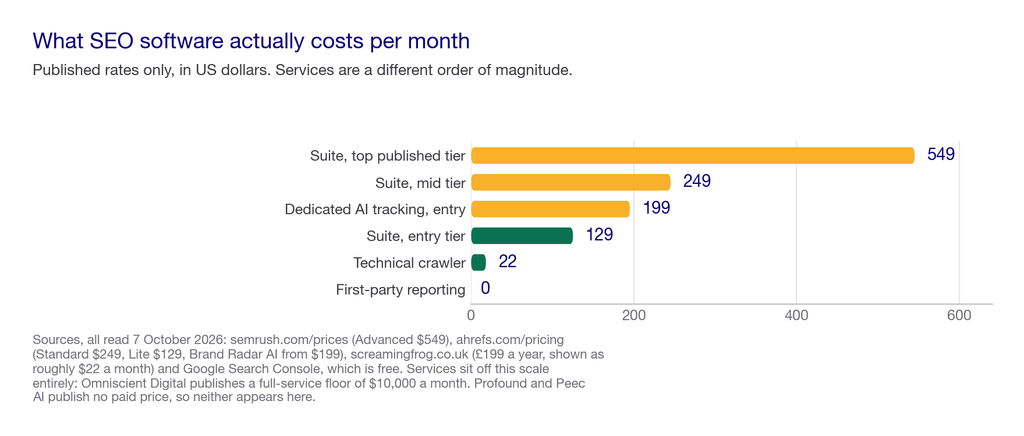
The suite band runs roughly $129 to $549 a month. Ahrefs Lite is $129 and Advanced is $449, with Enterprise at $1,499 on an annual commitment. Semrush runs $139 for the SEO plan up to $549 for Advanced, billed monthly, with lower annual rates published alongside. Both include AI prompt tracking, and both meter it tightly.
The dedicated AI band is mostly unpriced. Profound publishes a free trial and a custom Enterprise tier and nothing between them. Peec AI publishes four tier names with no figures. That is a real change from earlier in the year, and it means comparison shopping in this band requires a sales conversation.
The service band, and the caveat
The agency band starts around five figures a month. Omniscient Digital publishes a floor of $10,000 a month for full-service engagements. The other four agency sites we read the same morning publish nothing, which is normal for the category. Our wider benchmarks are in SEO agency cost in 2026.
The caveat we will not dress up. We know what these vendors publish, not what they charge. Negotiated rates, annual commitments and bundled credits move the real number, and anyone presenting a tidy comparison table of effective prices is guessing.
The agencies, and what each one says it does
We read five agency sites on the morning of 7 October 2026. Every one leads with AI search rather than classic SEO, which tells you how fast the service side has repositioned.
- Omniscient Digital. “SEO, GEO, and content should drive business growth, not just traffic.” An organic growth agency for B2B software, covering strategy, technical work, production, link building and digital PR. The only firm here publishing a floor price, at $10,000 a month for full service.
- Siege Media. “Full-service GEO. We make brands the answer in search.” Content, design, digital PR and affiliate work alongside search, across eight named verticals rather than software alone.
- Foundation. “Visibility in LLMs. Pipeline in your CRM.” Describes itself as an AI visibility and GEO marketing agency, with strength in third-party presence: digital PR, executive visibility, Reddit and YouTube.
- Ten Speed. A US-based organic growth agency helping B2B companies increase visibility across Google and LLMs, with original research and case studies as named services.
- Minuttia. Search strategy “from Google to ChatGPT to whatever comes next”, referencing more than 60 B2B SaaS clients, with both human and AI content creation named separately.
Where it falls short. Five sites read on one morning is a snapshot of positioning, not an assessment of quality. None of these firms has been evaluated by us, we have no commercial relationship with any of them, and a homepage tells you what a company wants to sell rather than what it is good at.
Tool or agency: what you are actually buying
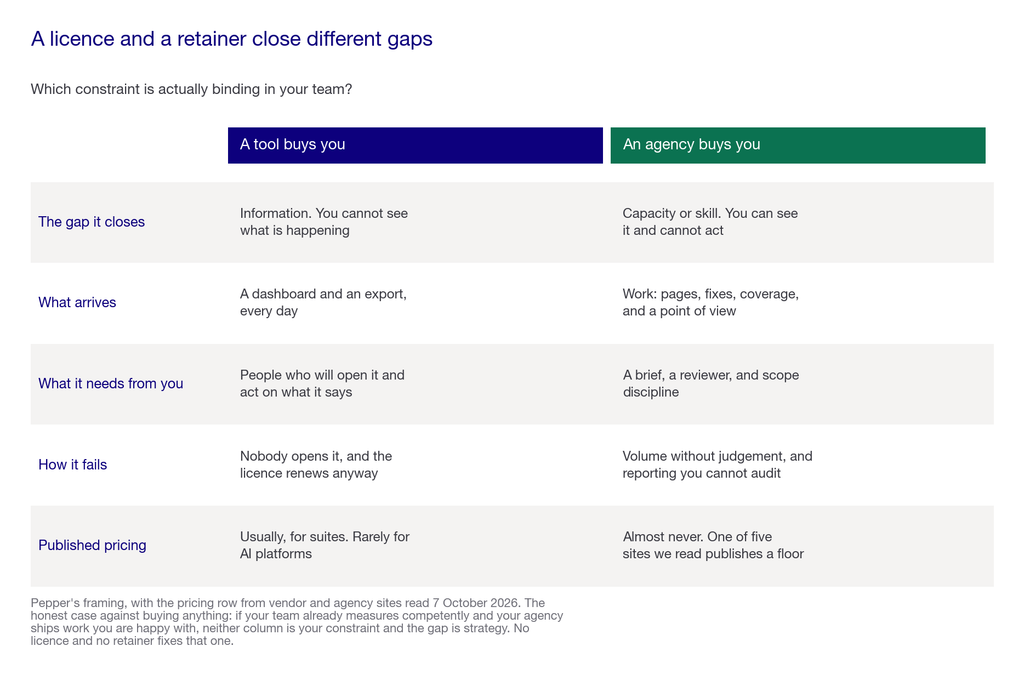
The question is rarely which is better. It is which of two gaps you have.
A tool closes a visibility gap. You cannot see what is happening, you have people who can act once they can see, and the constraint is information. A licence is cheap, fast and sufficient. The full version of that argument is in GEO platform without an agency.
An agency closes a capacity or capability gap. You can see the problem and nobody has the hours or the specialist skill to fix it. No licence solves that, and buying one usually produces a dashboard nobody opens.
Three situations where the answer is clear.
- A technical problem with an in-house developer. Buy the crawler, not the retainer. Screaming Frog plus Search Console will find it, and you have someone who can fix it.
- No content production capacity at all. Buy the agency. A tool telling you to publish twelve pages does not help if nobody can write them.
- Measurement you do not trust. Buy the measurement, from whoever you buy it, and keep it independent of whoever produces the content. Marking your own homework is the oldest problem in this market, and we set out the comparison discipline in how to benchmark AI visibility against competitors.
The honest version for us. If you have a working agency and an in-house team that acts on data, you do not need a platform to tell you that you are doing well. Buy the measurement layer and keep everything else. We would rather say that than sell you a seat you will not open.
How to choose between SEO optimization tools and agencies
Choosing here is less about features and more about which constraint is actually binding in your team. I would start by naming that constraint out loud, because most procurement in this category starts with a demo and never returns to the question.
Google’s own position is a useful anchor before you spend anything. Google says optimising for its AI features still rests on standard SEO fundamentals rather than a separate discipline. It has also warned buyers for years against providers who guarantee rankings. I think that is right about Google, and incomplete about the market, because ChatGPT, Perplexity and Claude are not Google and their source behaviour differs. That gap is what you are buying coverage of.
The scorecard I would use
| Area | Weight | What a strong option should demonstrate |
|---|---|---|
| Coverage of the engines your buyers use | 25% | Names the engines explicitly and tells you which tier includes which, rather than saying “all major AI platforms” |
| Prompt capacity against your category | 25% | Enough tracked prompts to cover the questions your buyers actually ask, with a published number you can check |
| Execution capacity | 20% | Someone can actually change the site: technical fixes, pages, structured data, third-party presence, not just a list of recommendations |
| Evidence of outcomes | 20% | A named client, a specific query, and a change you can verify yourself in an engine today |
| Commercial transparency | 10% | A published price or a straight answer on the floor, and clarity on what happens when scope moves |
The weights sum to 100 and they are mine. Note how much sits on the first two rows: engine coverage and prompt capacity are where most disappointment in this category originates, because both are easy to gloss in a demo and expensive to discover afterwards.
The live test, with the prompts
Do not accept a scripted demo. Give the vendor or the agency 20 to 30 commercial questions from your own category and ask them to run them in front of you. A usable set looks like this:
- “Best [your category] software for enterprise”
- “Best alternatives to [your main competitor]”
- “What should I look for when choosing [your category] software?”
- “Is [your brand] any good for [your main use case]?”
- “How much does [your category] software cost?”
Then ask for five things back: where your brand appears today, which competitors appear instead, which sources are shaping those answers, why those sources are winning, and exactly what they would change in the next 90 days.
A credible vendor will add something unprompted: that these answers are probabilistic. Independent research across five systems and 11,000 real queries found identical questions produce “structurally different information realities across systems”. One run on one engine proves nothing, and anyone presenting a single screenshot as evidence has told you how deeply they understand the medium.
The weaker playbook and the stronger one
The weaker playbook is familiar. Buy the suite with the best-known name, use the AI module that came bundled with it, track a handful of prompts, screenshot the ones that go well, and report rankings beside them.
The stronger model goes in a different order. Work out which questions your buyers ask. Check whether your pages are reachable and parseable at all. Measure mentions and citations across more than one engine, against named competitors. Find out which third-party sources engines reach for in your category, using the method in how to find which sources AI cites. Then decide whether the gap is information, capacity or capability, and buy accordingly.
The difference matters because being named, being cited and influencing the answer are three distinct outcomes. A product that reports one number for all three will let you optimise the wrong one for two quarters.
Red flags, named
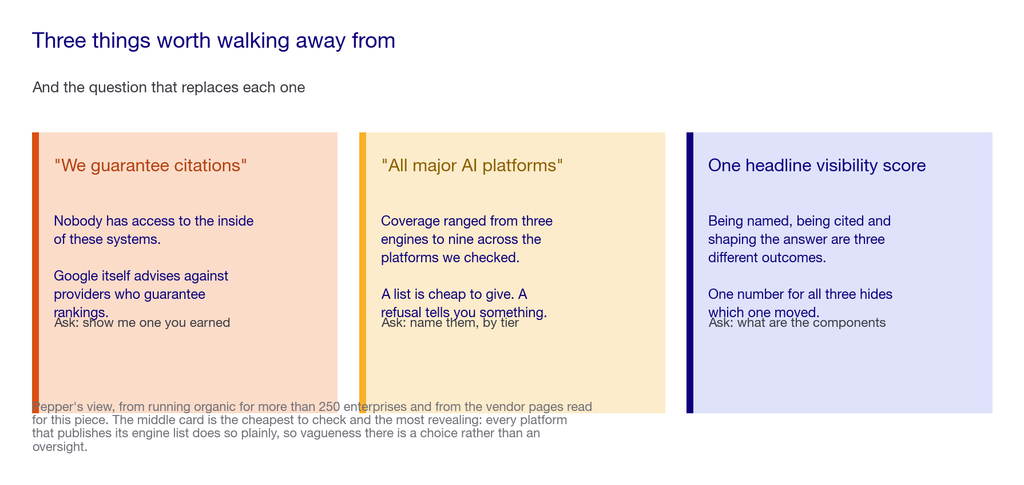
Start with the one that should end the call: anyone guaranteeing a citation in ChatGPT or a position in AI Overviews. Nobody has access to the inside of these systems, and Google explicitly advises against providers guaranteeing rankings for that reason.
Then the rest. A vendor who will not tell you the prompt allowance on your tier. An agency whose reporting is rankings with an AI slide appended. “All major AI platforms” with no engine list. A single composite visibility score presented as the headline number, which we argue against at length in should you trust a single AI visibility score. A proposal built on publishing volume. And a refusal to name who does the work, which matters as much for tools with managed services as it does for agencies.
Five questions, and what a good answer sounds like
- “Exactly which engines does my tier cover, and how many prompts?” A good answer is two numbers and a list. A bad answer is a reassurance.
- “Show me a query where a competitor beats us and explain why.” This separates people who understand retrieval from people who have memorised the vocabulary.
- “What will you actually change in the first 90 days?” You want technical, on-page and third-party work in the answer, not a content calendar.
- “How do I verify this myself?” The right answer invites you to run the prompts independently. Anyone discouraging that is protecting something.
- “What part of your method do you expect to be obsolete in a year?” This field is barely two years old. A thoughtful answer indicates somebody is reading the research rather than selling a permanent algorithm.
The reducing principle
If I reduce the whole decision to one sentence: buy the thing that closes your actual constraint, and refuse to let a demo redefine what your constraint is.
And the part that costs us something. If your team already measures its own visibility competently and your agency ships work you are happy with, you do not need another platform in the stack. The honest answer is sometimes that the stack is fine and the strategy is not, and no licence fixes that.
What nobody should promise you
- A guaranteed ranking or citation. Google warns against providers who guarantee rankings, and no vendor has access to the inside of an AI engine.
- That one tool covers every engine. Coverage varies by product and by tier, from three engines to nine among the platforms we checked.
- That a bundled AI module equals a dedicated platform. Five tracked prompts and five hundred tracked prompts both appear as a feature tick.
- A tidy market price list. Two of the platforms we checked publish no paid prices at all, and most agencies publish nothing. Anybody showing you an effective-price table built it from guesses.
Frequently asked questions
What are the best SEO optimization tools in 2026?
It depends on the gap. Search Console and Screaming Frog cover technical diagnosis cheaply, Semrush and Ahrefs cover research and rank tracking with limited AI prompt allowances, and dedicated AI platforms cover engine visibility at prices mostly set by sales conversation.
How much do SEO tools cost?
Published monthly rates ran from free to $1,499 on the day we checked. Ahrefs lists $129 to $449 across its main tiers with Enterprise at $1,499, Semrush lists $139 to $549 billed monthly, and Screaming Frog is £199 a year.
Tools versus agencies
Should I buy an SEO tool or hire an agency?
Buy a tool when the constraint is information and you have people who will act on it. Hire an agency when the constraint is capacity or specialist skill, because no licence produces pages, fixes architecture or earns third-party coverage.
Does my existing SEO suite cover AI visibility?
Partly, and check the allowance. Ahrefs includes 5 to 20 tracked AI prompts depending on tier, and Semrush includes 50 to 200 daily. That is useful for a sample and thin for a category question set. Building the set properly is covered in how to track brand mentions in AI search.
Why do AI visibility platforms hide their pricing?
We cannot tell you why, only what changed. Profound published a $99 and $399 ladder earlier in 2026 and now shows only a free trial and a custom Enterprise tier, and Peec AI has never published figures at any tier.
Getting value from either
What should an SEO tool report in 2026?
Rankings and traffic, plus whether AI engines name your brand and cite your pages, trended against named competitors across more than one engine. A single composite score is a packaging decision rather than a measurement.
How many prompts do I need to track?
More than a sample. A category question set typically needs enough prompts to cover awareness, comparison and purchase questions across your main use cases, which is usually well beyond twenty.
Can I use free tools only?
For a smaller site, further than most people expect. Search Console, Analytics and a 500-URL Screaming Frog crawl answer most technical questions, and running your own prompts manually costs an afternoon.
Sources
Every price was read on the vendor’s own pricing page on 7 October 2026. Pricing in this category moves, so re-check before committing
Independent research
- Huang, Goyal, Saha and Chandrasekharan, Answer Bubbles: Information Exposure in AI-Mediated Search, arXiv, 17 March 2026, revised 28 August 2026. 11,000 real search queries across five systems. Finds identical queries produce “structurally different information realities across systems”. Academic preprint, not peer-reviewed at the time of writing.
- Google Search Central guidance that optimising for AI features rests on SEO fundamentals, and its standing advice against providers who guarantee rankings.
On what this page is not
This is a pricing snapshot and a decision framework, not a ranked list or a scorecard. We sell in an adjacent category, so scoring these vendors would be marketing presented as research. We have reported what each publishes, said clearly where a vendor publishes nothing, and left our own pricing in the same unpublished state we would criticise in anyone else. Nothing here is based on using these products in a controlled comparison, and we would not claim otherwise.
Latest Blogs
Most advice on this is inference dressed as fact. OpenAI documents exactly one thing clearly, which is access. Here is what is documented, what is inferred, and how to verify the rest for yourself.
Being named in an AI answer and having your page used as its source are different outcomes with different causes and different fixes. The gap between them is the most useful diagnostic in AI search, and most reporting collapses it into one number.
Every platform reports share of voice and almost none of them define it the same way. Here is the definition worth using, the three choices that change the number, and how to measure it yourself without buying anything.
Get your hands on the latest news!

Similar Posts
Artificial Intelligence
11 mins read
What is anchor text, and does it still matter in 2026?
SEO
11 mins read
What is internal linking? Meaning, and what changed for AI search
SEO
15 mins read