The enterprise SEO resource library: 30 guides, frameworks and templates
The short answer
Thirty resources, grouped by the job you are trying to finish rather than by format. Every link was checked on 18 September 2026, which is the only thing that separates a library from a link dump after a few months. Twenty-six are ours and four are primary sources you should read yourself rather than take our word for. Two of our own entries carry a caveat, because Google published guidance in July that partly supersedes them, and flagging that seemed better than leaving you to find out.
Key takeaways
- Every entry was verified at source on 18 September 2026. We checked 85 candidates and dropped 5 that no longer resolve.
- Organised by job, not by format. Diagnose, decide, build, measure. You almost never want “all the frameworks”, you want the next thing.
- Templates are the scarcest category and we are not going to pad it. Real templates you can run are rarer than guides, in our library and everywhere else.
- Two of our own entries are flagged as partly superseded. Google’s guidance, updated 10 July 2026, states Search does not use llms.txt files. Anything of ours recommending them needs reading with that in mind.
- Four primary sources are included deliberately. Google, Microsoft, a peer-reviewed study and a large citation analysis. On the questions that matter most, read the original rather than anyone’s summary of it.
- Pepper is an agentic organic growth engine and an organic growth partner. Agent Atlas gives your team the agents. Pepper’s GEO platform reports Brand Visibility, Domain Prompt Presence and Share of Voice. A growth team works alongside yours. Eight years, more than 250 enterprises, more than 10 million tracked prompts.
A note on where this comes from. My job is why some content gets used and most does not, and resource libraries are a good demonstration of the problem: the value is in what gets left out. Pepper runs organic for more than 250 enterprises over eight years and tracks more than 10 million prompts across every major engine, so the ordering below reflects the sequence those programmes actually run in.
Disclosure: Twenty-six of the thirty entries are Pepper’s own work, which makes this a self-interested list and we would rather say so up front. We have not linked a single competitor, which is a house policy and also a real limitation of this library: there is good work elsewhere that you will not find here. The four primary sources are included precisely because they are not ours.
What is an enterprise SEO resource library, and what makes one worth using?
A resource library is a curated index: someone else has read a lot of material and kept the part that survives contact with real work. That is the whole value proposition, and almost every library on the internet fails it in the same two ways.
The first is rot. Links break, pages move, guidance gets superseded, and nobody re-checks. A library published eighteen months ago and never verified is worse than no library, because it looks authoritative while sending you to dead pages and retired advice.
The second is padding. Thirty is a rounder number than nineteen, so libraries get padded to thirty, and the reader cannot tell which entries earned their place.
So the standard we set ourselves was narrow: every entry verified on the day of publication, every entry with a stated limitation, and no entry included to reach a number.
If the vocabulary here is new, start with our glossary of core AEO terms, and our guide to enterprise SEO at scale is the pillar this library sits under.
What we checked, and what we dropped
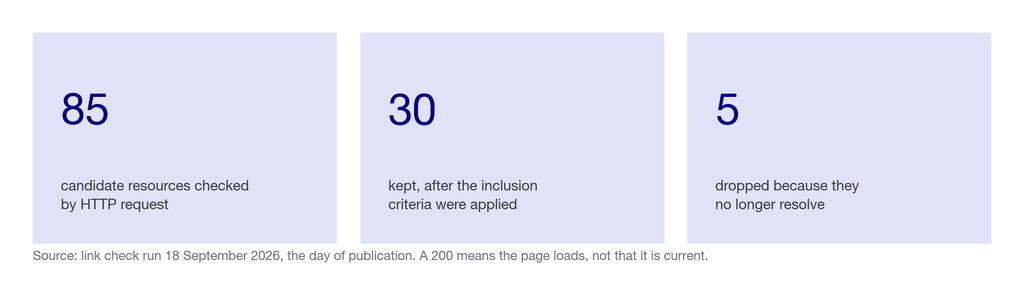
Eighty-five candidates, checked with an automated HTTP request on 18 September 2026. Eighty resolved. Five did not, and those five are not in this library regardless of how good they were.
Two entries are included with a caveat rather than dropped. Google’s guidance on optimising for generative AI features, page last updated 10 July 2026, states that “Google Search itself doesn’t use” llms.txt files and that adding one “will neither harm nor help your site’s visibility.” Any resource of ours that treats llms.txt as a priority is partly superseded by that, and we have marked those entries rather than quietly removing them.
Where this falls short: an HTTP 200 means the page loads, not that the content is current. Five of the thirty were published before June 2026, and a page can be live and stale at the same time. The caveat flags catch the cases we know about, and there will be others we have not caught.
If you would rather see where you stand than read about it, book a growth audit and we will show you what engines say about your brand today.
How we built this library
Five criteria, fixed before any candidate was assessed.
| Criterion | Weight | What it means |
|---|---|---|
| Resolves on the day of publication | 30 | Checked at source, not assumed from a bookmark. A dead entry makes the whole library untrustworthy |
| Answers a question someone actually has | 25 | It maps to a real job in a real programme, rather than filling a category in a taxonomy |
| States its own limitations | 20 | The resource is honest about what it does not cover, which is what makes it safe to hand to a colleague |
| Primary where primary exists | 15 | On questions where an engine operator or a peer-reviewed study has published, that source is included rather than our summary of it |
| Not included to reach a number | 10 | If the library would be better at 27 entries, it is 27 entries |
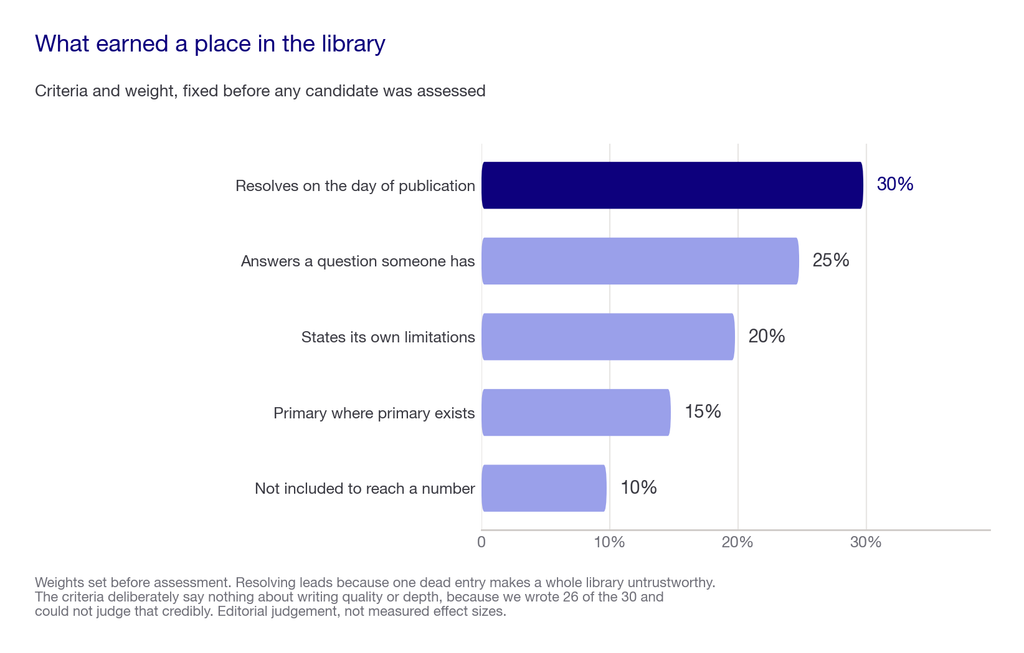
Where this falls short: the criteria say nothing about quality of writing or depth, because those are judgements we cannot make about our own work with any credibility. What they test is whether an entry is live, useful, honest and necessary.
What is actually in the library
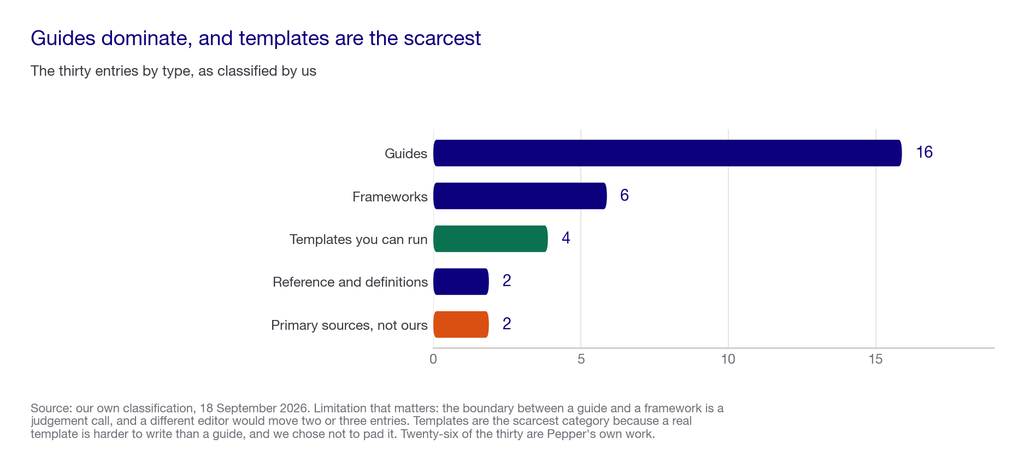
Guides dominate, which is true of every library in this category and worth naming rather than disguising. Templates are the scarcest, because a real template is harder to write than a guide and there are fewer of them. We would rather show you four good ones than pad the category to ten.
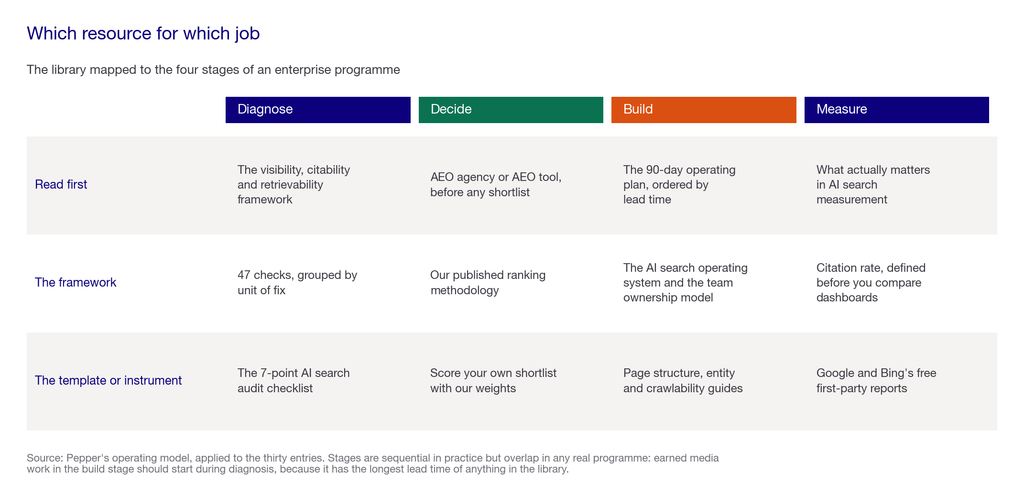
Which resource for which job
Stage one: diagnose
Where you are before you decide anything.
- The AI search framework: visibility, citability, retrievability. the three-stage model everything else here hangs off. Caveat: lists llms.txt under retrievability, which Google’s July guidance supersedes.
- The 7-point AI search audit template. the checklist we run on every new account. A template, not a guide. Falls short: it diagnoses, it does not prioritise.
- Can AI search bots crawl my website?. the technical access question, written for marketers rather than engineers. Falls short: tells you about access, not influence.
- The ChatGPT brand visibility audit. a single-engine diagnostic you can run yourself. Falls short: one engine, so do not read it as a market position.
- Enterprise SEO audit framework: 47 checks. grouped by unit of fix rather than by category, so engineering can size the work. Falls short: long, and genuinely for sites above about 10,000 pages.
Stage two: decide
What to buy, from whom, and whether to buy at all.
- AEO agency or AEO tool. the first question, before any shortlist. Falls short: framed for mid-market and above.
- What generative engine optimization costs. a census of published prices rather than an invented range. Caveat: two platform prices in it have since been withdrawn by their vendors.
- Enterprise SEO pricing. what large organisations actually pay, and the fact that almost nobody publishes it. Falls short: a census of published prices, not of the market.
- SEO agency pricing by model and scope. the four engagement models and where each one breaks. Falls short: below enterprise scope.
- Best SEO platforms for B2B. eleven platforms scored on whether they reach your pipeline data. Falls short: scores disclosure, not product quality.
- Best AI search visibility tools. fourteen platforms ranked by sampling rate. Caveat: two vendors have repriced since.
- Best AEO platforms. seven AEO-native tools on engine coverage and insight-to-action. Falls short: does not cover classic SEO platforms.
- AEO agencies for B2B and enterprise. ten agencies scored on the evidence they publish about enterprise readiness. Falls short: a disclosure audit, not a capability audit.
- Our GEO agency ranking methodology. how we score, published so you can disagree with it. A template you can reuse on your own shortlist.
- SEO audit agencies and what to pay. what a purchased audit must contain to be worth buying. Falls short: only two agencies publish a price.
Stage three: build
The work itself.
- How to improve your brand’s AI presence: a 90-day plan. the operating sequence, ordered by lead time. The closest thing here to a project plan.
- The AI search operating system. how the function runs once it is more than a project. Falls short: assumes you have people to run it.
- The AI search team ownership model. who owns what, which is the question that stalls most programmes.
- AEO page structure, H1s and FAQ strategy. how to build a page that answers rather than ranks.
- How to structure content for AI citation. the sentence-level version of the same problem.
- How to get cited in LLMs. the citation mechanics across engines.
- Entity optimization for AI search. making your brand a thing engines can identify and verify.
- Crawlability for AI and robots.txt for AI crawlers. the two access documents, counted as one entry because you will read them together.
- Schema markup. the standard implementation reference. Caveat: Google states there is no special AI schema, so treat schema as ordinary good practice rather than an AI tactic.
- LLM seeding. getting mentioned in the places engines read. Falls short: slow, and the hardest thing here to do well.
Stage four: measure
- What actually matters in AI search measurement. the metric framework, and which numbers to ignore.
- Citation rate. the core unit, defined. Read this before comparing anyone’s dashboard.
- AI visibility scores, and why one-shot numbers mislead. the warning that engines vary between runs.
Primary sources: read these yourself
The four documents we cite most, none of them ours.
- Google’s guide to optimizing for generative AI features. page last updated 10 July 2026. States that SEO best practices still apply, names four tactics you do not need, warns against tools promising ranking success, and points to Search Console’s generative AI performance report. Limitation: Google describes Google.
- Microsoft’s AI Performance report in Bing Webmaster Tools. public preview announced 10 February 2026. Free first-party citation data. Limitation: Bing’s surface only.
Two more worth reading in full, and neither is linkable from here as a standing entry because both sit behind publisher pages we do not control: Kaiser and Schulze, “ChatGPT Referrals to E-Commerce Websites”, Marketing Science Vol. 45 No. 4 (2026), covering 973 sites and 164 million purchases; and Muck Rack’s May 2026 analysis of more than 25 million cited links, the source of the widely quoted finding that earned media carries 84% of AI citations. Both are named in full in our sources list below.
The library at a glance
| Stage | What it answers | Entries | Cost to use | Where it falls short |
|---|---|---|---|---|
| Diagnose | Where do we actually stand | 5 | Free | Tells you the gap, not the fix |
| Decide | What should we buy, and from whom | 10 | Free to read, and the decisions cost from $29 a month to $3,000 | Published prices move; two entries already carry stale figures |
| Build | How do we do the work | 10 | Free to read. The work needs writers and engineering time | The slowest item, earned media, takes a quarter |
| Measure | Did it work | 3 | Free, with two free first-party reports | No platform attributes AI visibility to revenue |
| Primary sources | What do the operators actually say | 2 linked, 2 named | Free | Google describes Google; Bing describes Bing |
| Pepper, own row | Agents, platform and a growth team | Not published | Budget is a conversation, not a page | We publish no pricing |
## What this library costs, and what the work costs
- Every entry is free to read. There is no gate, no form and no email capture on any of the thirty, which is deliberate.
- The measurement layer can also be free. Both first-party AI performance reports, Google’s and Bing’s, cost nothing.
- The decisions these resources inform are where money starts. AI visibility software runs from $29 a month to about $500 for mainstream tiers, and the two agencies publishing a GEO retainer both start at exactly $3,000 a month.
- The largest cost is not in any of these documents. It is your own team’s time and the engineering capacity to ship what the audits find. No guide changes that, and a library that implies otherwise is selling something.
How Pepper uses this library
Pepper is an agentic organic growth engine and an organic growth partner, and this library is genuinely the reading list we hand new clients.
- Agent Atlas turns the repeatable parts of these documents into workflows your team runs. Agents are workflows. System agents stay fixed, user agents stay editable and versioned, and customers log in and build and run their own inside Atlas. Most of the build-stage entries above describe work that should be a workflow rather than a document.
- Pepper’s GEO platform is the measurement stage. Brand Visibility for how often engines mention you, Domain Prompt Presence for how often they cite a page from your domain, and Share of Voice for your slice of the category. The gap between the first two is the citability diagnostic. See the platform.
- A growth team works alongside yours on the part no document does for you.
- Proof rather than adjectives. Acceldata went from 85 to more than 300 top-three keywords with 6X organic traffic growth. More in our case studies.
Where this falls short, and it is the obvious objection. Twenty-six of thirty entries are ours, so this is a library assembled by an interested party. We have been explicit about the policy that produced that, which is that we do not link competitors. If you want a genuinely neutral reading list, this is not it, and the four primary sources are the part of this page you should trust most.
How to choose what to read first
I would not read a library front to back. I would find the one question blocking you this week and read the two entries that answer it.
Here is the 100-point scorecard I would run over any resource library, including this one.
| Area | Weight | What a trustworthy library demonstrates |
|---|---|---|
| Entries verified with a stated date | 30 | It says when the links were checked, because rot is the default state of a link list |
| Limitations stated per entry | 25 | Each item says what it cannot do, so you can hand it to a colleague without a warning |
| Superseded entries flagged, not hidden | 20 | When newer guidance contradicts an entry, the library says so rather than deleting the evidence |
| Independence declared | 15 | It tells you who wrote the entries and what the publisher sells |
| Organised by job, not by taxonomy | 10 | You can find the next thing without reading the whole index |
**Then run the live test, on this library as readily as on anyone else’s.** Take the 25 questions your team actually asks, and check how many any library answers within two clicks over 90 days of real use. For example: “which of these tells me if AI bots can reach our site”, “which one prices the work”, “which one tells me what to measure”, “which one is out of date”.
Ask any library five things. When was it last verified. Who wrote the entries. What is deliberately excluded. Which entries are superseded. What it wants from you in exchange.
Five questions worth asking, and what a good answer sounds like.
- “When were these links last checked?” If there is no date, assume never. We checked ours on 18 September 2026 and say so twice.
- “How many entries are the publisher’s own?” Ours is 26 of 30, and that is a real limitation rather than a badge.
- “What was excluded and why?” We dropped five candidates because they no longer resolve.
- “Which entries are out of date?” Two of ours are flagged, for llms.txt.
- “What does it cost me to use?” Nothing here is gated, and a library behind a form is a lead magnet with a library’s job title.
Red flags in a resource library.
- No verification date, which means the links have not been checked since publication.
- A round number of entries, which is usually padding rather than curation.
- No stated limitations, so every entry looks equally good and none can be trusted.
- Superseded advice left unmarked, particularly anything treating llms.txt as a ranking factor after July 2026.
- A form in front of it, which makes it a lead magnet rather than a reference.
- Competitor links presented as neutrality when the list is still curated by an interested party. We solve this by declaring the policy rather than pretending to neutrality.
The weaker way to use a library like this. Bookmark it. Feel prepared. Read nothing. Return in four months and follow a link to guidance that changed in July.
The stronger way. Pick the stage you are actually in. Read two entries. Do the thing. Come back when the next question appears. A library used four times in a quarter has earned its place in your bookmarks, and one used once has not.
If I reduce this to one principle: a library is only as good as its last verification date, and everything else is decoration.
The honest closing note, and it costs us something. If you only read two things from this page, read the two primary sources at the end. Google’s own guidance and Microsoft’s free report will do more for most teams than any of our twenty-six entries, and they cost nothing and owe us nothing.
What nobody should promise you
Nobody should promise a resource library is current unless they say when they checked. Rot is the default, and a 2025 library with 2026 in the title is the most common form of it.
Nobody should promise a document will fix an execution problem. Everything here describes work that still has to be done by people with time.
Nobody should promise neutrality while curating a list of their own articles. We have not, and you should discount any library that does.
Where this stops working, including for us
If your site is under about 10,000 pages, the enterprise-scale entries will over-serve you. Use the diagnose and measure stages and skip most of the rest.
If you already know what to do and cannot get it shipped, no entry in this library helps. That is a prioritisation problem inside your organisation and reading more will make it worse, not better.
Where Pepper falls short: 26 of 30 entries are ours. We do not link competitors, and that policy makes this library less useful than a genuinely independent one would be.
Where to go next
Pick your stage and read two entries, not thirty. If you do not know your stage, run the 7-point AI search audit template, which takes an afternoon and will tell you.
Then set up the two free first-party reports before you buy anything at all. To see where you stand across engines first, see where you show up.
Frequently asked questions
What is in this enterprise SEO resource library?
Thirty resources grouped by job: five for diagnosis, ten for buying decisions, ten for building, three for measurement, and two linked primary sources from Google and Microsoft. Twenty-six are Pepper’s own and four are not.
How often is this library checked?
Every link was verified with an HTTP request on 18 September 2026, the day of publication. We checked 85 candidates and dropped five that no longer resolve. We will re-verify quarterly and change the date at the top when we do.
Are any of these resources out of date?
Two are flagged. Google’s guidance, updated 10 July 2026, states Search does not use llms.txt files, so any entry of ours treating them as a priority is partly superseded. Two more carry pricing figures that vendors have since withdrawn.
Why are there no competitor resources in this library?
House policy: we name competitors but never link them, so this page passes no authority to firms we compete with. It is an honest constraint and it does make the library less complete than a neutral one would be.
Which resource should I start with?
Whichever matches your stage. If you do not know it, run the 7-point AI search audit template first, because it takes an afternoon and tells you which of the four stages you are actually in.
Are there real templates here, or just guides?
Four genuine templates you can run: the 7-point audit checklist, the 47-check enterprise audit framework, our published ranking methodology, and the ChatGPT visibility audit. Templates are the scarcest category and we have not padded it.
Do I need to pay for any of these?
No. Every entry is free and none sits behind a form. The decisions they inform cost money, starting at $29 a month for software and $3,000 a month for a published GEO retainer.
What is missing from this library?
Independent third-party work, which our linking policy excludes. Also anything on paid search, social or lifecycle, because this library is scoped to organic and AI search for enterprise teams.
Sources and further reading
- Link verification: 85 candidate URLs checked by automated HTTP request on 18 September 2026. Eighty resolved, five did not and were excluded. Method and result stated here so the claim is checkable rather than asserted.
- Google Search Central, guide to optimizing for generative AI features, page last updated 10 July 2026 and read at source 18 September 2026. Source of the llms.txt caveat applied to two entries, of the statement that there is no special AI schema, and of the reference to Search Console’s generative AI performance report. Google describes Google Search only.
- Microsoft, AI Performance in Bing Webmaster Tools, public preview announced 10 February 2026.
- Maximilian Kaiser and Christian Schulze, “ChatGPT Referrals to E-Commerce Websites: How Do LLMs Compare Against Traditional Channels?”, Marketing Science, Vol. 45 No. 4 (2026). 973 e-commerce sites, more than 50,000 ChatGPT-referred purchases against 164 million from traditional channels, August 2024 to July 2025. Named rather than linked because the publisher page returned a 403 when we last checked.
- Muck Rack, What is AI reading? May 2026 edition, published 7 May 2026, analysing more than 25 million cited links across ChatGPT, Claude and Gemini in 17 industries. Source of the 84% earned-media figure referenced throughout our work.
- Pepper, the complete guide to running SEO at scale, the pillar this library sits under, and the glossary of core AEO terms for the vocabulary used throughout.
- Pepper, Acceldata case study. One account, not a benchmark.
What is not here, and why. No competitor resources, per our linking policy, which is the largest single gap in this library and is stated three times rather than hidden. No gated assets, because a library behind a form is a lead magnet. No entry included to reach thirty: the number is what survived the criteria, and if it had come to 27 the title would say 27. No quality ranking of the entries against each other, because we wrote 26 of them and could not score that credibly. Five candidates were dropped for failing to resolve and are not listed, because a list of dead links helps nobody.
Latest Blogs
Every agency lists the same dozen services. Almost none of them tells you how much of each you get, which makes the list unusable for comparison. One agency does publish full quantities per tier, so we divided its prices by its deliverables. The result inverts the ladder: the cheapest plan is the best value per page, and the first upgrade costs 3.4 times the entry rate for each additional page it buys.
The short answer The three terms name three surfaces, and that part is real. What is not real is the implication that they need three playbooks, three teams and three budgets each. Google states that its generative features run on core Search ranking systems. In July it also named four AI-specific tactics it does not […]
Most resource libraries are link dumps that rot quietly. We built this one the way we build everything else: 85 candidates checked at source on one day, 30 kept, 5 dropped because they no longer resolve, and two of our own entries flagged as partly superseded by newer guidance from Google. Every item says what it is for and what it cannot do. It is organised by the job you are trying to finish, not by content type.
Get your hands on the latest news!

Similar Posts
SEO
15 mins read
SEO agency services in 2026: what’s included, how much it costs, and how to choose
Artificial Intelligence
15 mins read
AEO vs SEO vs GEO: the differences that actually matter in 2026
GEO / AI Search
14 mins read